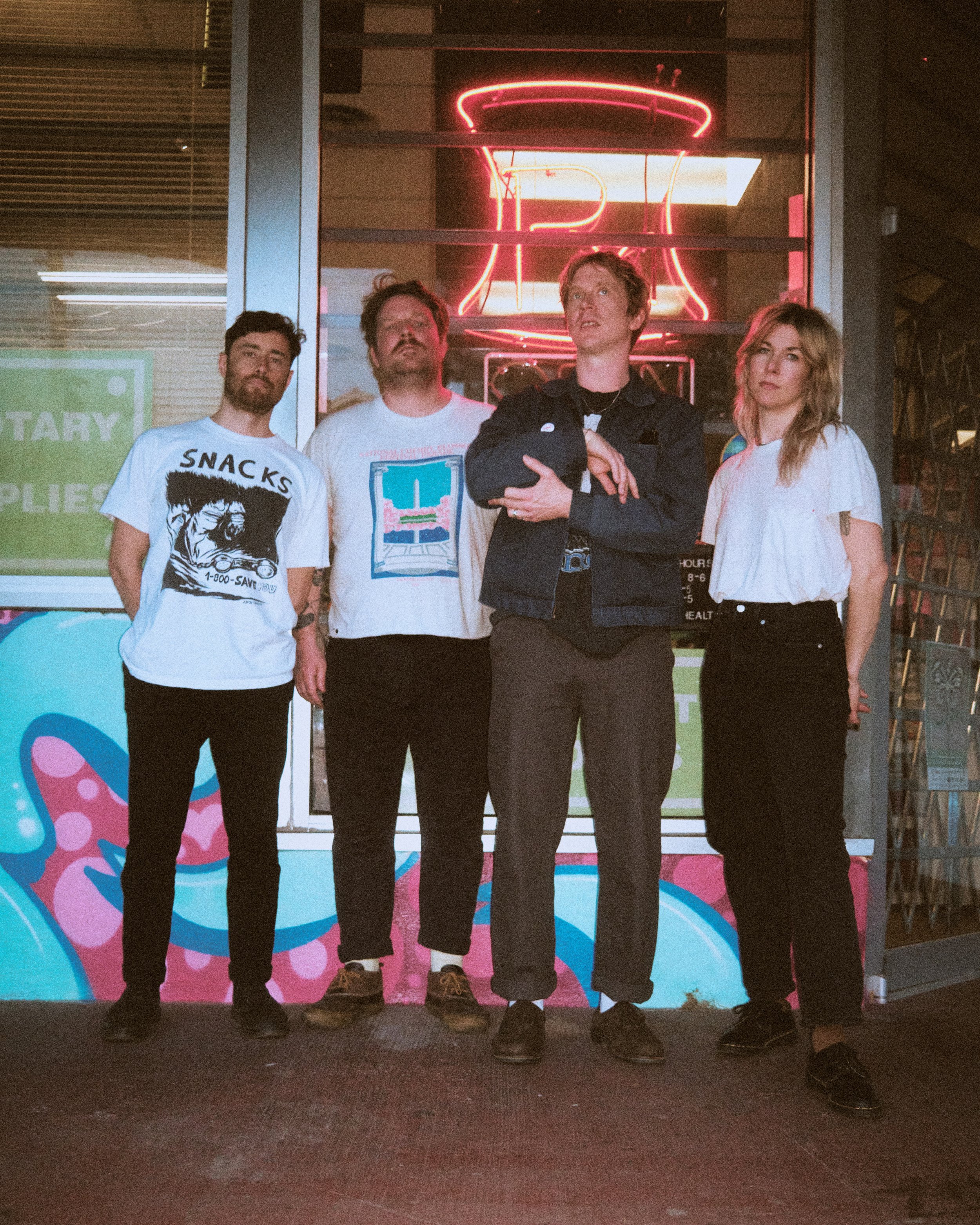
Ultra Lights
Ultra Lights began as a pandemic recording project in a homemade studio. Now a full-fledged band with their debut album on the way, the project evolved from frontman John Robinson’s desire to escape the 'jaded' cycles of being in a band.
On “Pleasure’s All Yours," they embrace creative limitations and a dreamer’s mindset, resulting in a sound that’s more honest and relatable than Robinson’s past work. The album is out July 10, and recently, Robinson and guitarist Leela Hoehn spoke about the experience of building this band and the evolution of its sound.
Listen to this interview anywhere podcasts are available.
The following transcript was generated with transcription software and reviewed for accuracy. Minor errors or omissions may remain.
YY: John, when you were first starting out, I know you were kind of teaching yourself how to record. And now, here you guys are, a full band with a debut album on the way. Was this always the plan, or were you just originally looking for something to keep you busy during the pandemic?
JR: Oh yeah. No, I mean, I was always planning on writing another record because I've been in bands for like the last like 20 years, and I was kind of on a hiatus during the pandemic. That's everybody, I guess kind of was. But yeah, it was a focus of, of creating a new band. It just, it wasn't necessarily Ultra Lights wasn't the band. It was kind of a different band I was trying to start. And then we moved back to Atlanta after everything kind of opened back up again. And the music that I was working on during the pandemic, kind of like, you know, was the starting point for this band. And then when we all got together, I started writing more of like, what is on the record. And most of the, that early EP that we have, like most of that was written after everybody had joined the band.
Okay. So it was recorded, mixed, produced by Chris Sampson, mastered by Mikey Young. Do you think any of those recording skills that you picked up, do you think those made the recording experience a little different with Ultra Lights compared to your past projects that you mentioned?
JR: Yeah. I mean, now I understood the language a little bit better to get what I needed in the studio versus when I was younger. I would go into the studio and I wouldn't know how to capture like my vocals the way I wanted them to. So a lot of the times I would just do double vocals over like my whole vocal-- and I didn't ever really like the way it sounded. I didn't like the way my voice sounded when I was younger, so I was always trying to find a way to basically hide that I was insecure with my voice. But after recording on my own, I just like I worked on my voice a lot and got it to where I just liked the way it sounded. And like I said, I knew more about what I wanted out of the sound. I just didn't know exactly how to get it. So that's why working in a studio with someone that was more professional than me helped out. But yeah, I knew a little bit more about the language to know how to get what I wanted. Yeah.
And not to say that you were like completely dissatisfied with how things sounded in the past, but did you ever have any sort of regrets on like past releases? It wasn't, you know, quite how you wanted it to be, and maybe this is different than that?
JR: Yeah. There's a band that I was in called Illegal Drugs and like my like I said, my vocals, I think are all just like doubled vocals on there and it just doesn't sound like what I was going for. But I mean, a lot of people love that album that live in Atlanta come up to me and like all the time and I'm like, oh, I love that Illegal Drugs record. And I'm like, well, I'm in a band now. Come, come check us out, you know? Yeah.
LH: It's a lot darker. I think like the vocals were like a lot darker of a sound in general and a more serious John too, I think.
JR: Well, yeah, there's that. The songs are like a lot different too. I was like going through a phase of being like, I was writing really poppy, like rock and roll when I was in my 20s. And then I was like, I want to change. I want to be like, play heavier music to where I can like, really get into it live. And then that got boring to me. And then now I'm back on like the poppier side of things.
LH: A little bit of both.
JR: Yeah, it's a little bit of both. Yeah. But it like works more with my sensibilities, I think.
Sure. I think I read something that called it was it nihilistic or like sardonic in a way. Is that, is that something you had intended from the start or you didn't really have much of a plan for how the material was going to turn out?
JR: Yeah. I mean, I wasn't like, oh, like, I'm gonna write about this specific type of thing. Yeah. It's just like, that's just what I'm writing about right now. When I was younger, I wrote a lot about like drugs and drinking and being sad or whatever the hell I wrote about. And then I was in a band like in my 30s. I was trying to write like darker material. And yeah, I just write about what I think about just like.
LH: Which are nihilistic thoughts.
JR: Which are nihilistic, existential, kind of just like, yeah, thoughts.
LH: I mean, yeah, I mean, it's what comes out for sure.
JR: Yeah.
And I thought this was interesting to read about. So obviously, you know, you guys have been together for a while. You've worked creatively together for years as well. But I understand this is your first musical project. I imagine, you know, your history has obviously lent itself very well to the band, but has there been anything new that you've learned about each other since, like being in the same band?
LH: Oh my God. Well, first of all, I was shocked that he even asked me to play with him because for years, I mean, I didn't even play guitar for years. So there's that. So I had, you know, during the pandemic when he was like teaching himself to record. I also taught myself how to play guitar. Just had a lot of extra time and just felt like there was kind of no reason not to because something I've just wanted to do forever. And I finally just committed to the time. But yeah, I mean, like we, we've worked on like little projects together. We've done like design projects together. We still do with the band, we collaborate on all the artwork. And we've had a store, we opened a store during the pandemic and we collaborated on that. And, you know, so we've had like other types of projects that we've done together as a couple. But musically, I'm like, I don't know, I think we're still kind of, I'm still kind of shocked at how fun it is to play together. Yeah. I mean, like, we're just, we, it's been awesome. I can't really complain. I mean, like, it's been challenging in a totally different way. But I think for me and him, it's John's been playing guitar since he was 11 years old and I've been playing guitar since I was 35, you know, so like, there's a large gap in terms of my skill level, but also like, because of how skilled he is in terms of like songwriting and like, just, I don't know, the way I learned was by playing his songs. And so like, and I had to learn kind of quickly. So just practicing every single week together as a group that would just like kind of it's been like a boot camp basically for like the past several, you know, a few years now. But it's been fun. I don't know, there's been a lot of challenges at first because I just didn't understand. Like when you're practicing and like you're like with the other guys, everyone's talking to each other. And at first i could not follow like, what the hell it was they were all talking about. I had no idea what part of the song I was supposed to be picking up on, like I was for him. Like, you know, learning recording. It was kind of like the same thing. Like I had no idea what the lingo was. And everyone says different things. There's no like, you know, unless you're just like a really well trained musician and you know, all the terminology. But still generally say the right thing. So I'm trying to take everything very literally. And anyway, so there was like a moment there where I was just like getting frustrated at every practice and feeling so worn out.
JR: Yeah. You overthink.
LH: Yeah. But then eventually, you know, like, yeah, you just get better and you just, you know, especially playing live and then adding in vocals and playing, playing and singing, you know, like all those things just like, I don't know, like I said, it's been a boot camp and it's been awesome.
JR: Yeah, I mean, I learned from Leela being in the band, how adaptable, like, you know, I mean, I've been with her for a long time, but definitely the fact that she was able to jump into being a band and be very, like professional with it and like fun still and not as scared as like, you know, a lot of people would be. And she has learned, you know, there's a lot of steps to be in a band. It's like, it's not just learning the songs. There's also like, all right, this cable goes into this input and then this input goes, you know, for the next pedal. And then you have to plug this in. You have to make sure you're daisy chained. So there's all these things like.
LH: You gotta do it again tomorrow night after all the lights have been turned off and stuff's messed up and you're going to have to do that on your own because he's going to be too busy.
JR: I'm going to be also doing that. But I'm, you know, I know what I'm doing. But it's like, yeah, there's a lot of that. And it's not just like Leela, like, yeah, this is her first band, but Alex that plays bass, he hasn't ever been on tour. So there's like that with both of them. You know, it's like they're kind of new to the trying to be a more professional band. I'm not the drummer is not. We've done it before, but it's I mean, it's cool to have that. It's cool to not just have like four jaded dudes in a band that have already done it before. It's cool to have people that are excited and have like more of a dreamer's mind about like what you can do with music.
LH: We have more energy than--
JR: Yeah I mean, I'm like so jaded. I'm like, nothing's gonna happen with this band. Like, you know, I'm like, I'm just trying to write music, you know, but like to have them. It's, it is helpful for me because it pushes me to actually care beyond like, I really care about writing music and playing a good show, but to have other people that are more positive, that can help me to be more positive.
I imagine it would help to have a lot of different mindsets and experience levels in the same band. It just sort of, you know, keeps things interesting.
JR: Yeah, yeah it does. It does make it more interesting. It's like the limits of, you know, I'm in a most like music that influenced me, like, you know, from when I was young, a lot of that has like, there were people that were limited in their skills or like, you know, all the early punk music, a lot of those people were just picking up instruments and starting you know, maybe one or two of the people on the band were like, you know, really experienced good musicians. But I've read a lot of books about like the beginning of punk or post punk or whatever. And it's like, it was a lot of people that didn't know what they were doing, and they made really interesting music.
LH: I think that when you're limited in what you know, you're just kind of forced to work with what you know, in a way that's just you're kind of stretching what's possible. And so I think that's true. Whenever you are a self-taught designer or artist or anything like that, you're kind of working within the resources that you're given. And to me, it's always been more interesting. Like I like, yeah, I mean, exactly like, why do we listen to punk? Because it's very reductive and it's like it's hitting a note somewhere else besides just like, you know, I could listen to it. I can also listen to a highly skilled musician, you know, or listen to an orchestra or something like that and feel similarly. But there's something about, I guess, working within limitations that I find way more interesting in almost every aspect of life, to be honest. You know, who wants to, you know, I'm not very interested in like watching a billionaire, you know, be able to do all these wonderful things that they get to do. It's like, that's not very interesting, right? It's way more interesting when you see that people are able to overcome odds, you know? So I feel like that's the case in, in any sort of little like way.
JR: Yeah. I mean, I was just talking to someone yesterday about like Beck and like, if you listen to Beck, like before he blew up with "Loser," you know, and he worked with the Dust Brothers. But if you listen, he was just making really weird music. He's just a weird dude in LA. And then he blew up really big, and he only worked with, like, big producers after that. And in my mind, I'm like, what would Beck's music career have been like if he would have just stayed being an independent musician? I think he would be more interesting. Yeah. Granted, like I think "Mellow Gold" and "Odelay" are like awesome records and he's put out cool songs since then. But like, I really like this. There's this album, "One Foot in the Grave" that's on K Records, you know, and it's way stripped down. It's way limited. And he never did that again. And that's because he was, he's always been working with super professional musicians and you know, engineers in the studio since then. And like, yeah, that also limits artists, I think is like having a big budget, having everything at your means. I think that limits people creatively.
You're literally forced to get creative when you have less tools at your disposal.
LH: Yeah, you need a little nudge, you know, and there's nothing wrong with being nudged.
JR: And you have more freedom. You have like freedom to be like, yeah, it's like, it doesn't matter as much.
LH: yeah, exactly. It feels like the stakes are lower. You can really tell there was a lot of work just put into the whole production of this album, down to the artwork, which you guys also collaborated on as well. Is that right?
LH: And my mom actually, so my mom is a painter and the, the table and the candlestick and the two paintings in the back on the cover are actually part of a painting that my mom did, and John just really liked it and asked for permission to use part of it. And so we just kind of worked our themes and our ideas like around that painting as like the central focus. And then that's just kind of what ended up developing out of that.
Did you wait to finish the album or like at least have the songs down before starting the artwork? Or did they kind of come about simultaneously?
JR: I think there were two songs that we wound up adding to the record, like after we had already started, like "Good Enough" and "Diamond Dreams." I wound up writing them like after we had already recorded what we thought was going to be the record.
LH: Yeah. And so I think we kind of had an idea, but to be honest, I don't think I started.
JR: Yeah, we didn't finish the album cover until like it was already like mixed. And yeah, I think mastered honestly. Yeah, I think so.
LH: We just have so much going on. So it was like, you know, it's, it's also on the flip side of like doing everything yourself. You are just still doing everything yourself. So it's like it can be, I don't know. For me, it can get a little like bottlenecky. Yeah. When you're like creatively, kind of like exerting too much like on multiple fronts. But yeah, I mean, we just took our time with it and we went back and forth with it. I mean, we collaborate pretty well, I feel like in general, but we do butt heads about like.
JR: Yeah, we disagree about just so much stuff on, on visual things.
LH: We're very different in a lot of ways. But it helps me, I think as a designer to see things differently and to rethink things. Like I can be more impulsive. I'm a little bit more fiery about like just wanting things to get done to like after a while. And then John's a little more slower paced, which is helpful with that because it makes me slow down and rethink it. And then turns out, unfortunately, he's right sometimes, most of the time about certain things and it's annoying, but.
JR: I mean, that's how I am with like recording too. And like recording with Chris, it was this experience was cool too, because there was never a moment where, you know, like I kept being like, I want to go back and remix this song. He wasn't ever like, dude, it's done. You know, like, get over it. He never did that with me. He was always willing to like, let me come back in and spin my wheels.
LH: Yeah.
JR: And like, yeah, working with Leela, it's like, I want to know that it's like, I'm happy with it before I'm ever done with anything. So yeah, I do have I take more time to get things done.
LH: Which yeah, it can be good. And sometimes it's like sometimes like the back of the cover. I think at some point I was just like, I'm going to do this part, because we need to be finished, you know, and finally it had to get done. But then like, yeah, it worked out. I like the way that the back end too.
Well, I wanted to also just talk about some shows you have coming up. I know it was recently announced that you'll be performing at the famous Fest in in Gainesville this year, which will be your first time playing there. And at the moment our Ultra Lights shows mainly sort of just limited to your local area? Because I know you still play.
LH: No, we kind of took a break booking anything for a minute there just so we could focus on releasing the album and we're really. Yeah, we have a show actually next weekend in Chapel Hill, North Carolina, for Dex Fest. And that'll be really fun Pylon, they're playing and like Entrez Vous is playing, but yeah, that's going to be really fun. And then we're trying to figure that out now actually, because, because we've been trying to focus on getting the album out and just kind of like getting everything finished. Now we're trying to, you know, get our stuff together to like book some shows in the fall.
JR: Yeah, I mean, we're doing it all ourselves. So it's just like, you know, there's all these, when I was younger, I used to have like contacts, you know, at a lot of places to where I could easily just be like, hey, like, can we set this show up? But like a lot of the bands that I used to play with, they're kind of in like they either have broken up by now.
LH: Yeah. So now we're just like, you know, just kind of a humiliating process to like reach out to, to booking agents and to like reach out to venues. And it's like, it's just, it's just humiliating. No one's going to admit, I don't know if anybody admits that, but it's just totally humiliating to be like, hi, you don't know me, but we're great. Can we play? And you're trying to also solicit support from a local band. So it's like you're also asking bands, you know, it's just a funny process. Like you're like, can you play with us? That's really going to help us more than it is for you. But at the same time, it's like the way you make contacts and we do trade shows and it's, you know, it's just funny as like a band that nobody knows, you know, trying to get their name out there. It's just always a funny process.
JR: We played New York a few times now and we played Chicago last year and Philly, like so we're doing the thing. It's just more of like, yeah, going out on the weekend.
LH: Yeah it's very condensed, right now at least. And like our goal is to, I mean, definitely for the fall, our goal is to play in Chicago. I would say probably like Chicago and in New York, like trying to figure out like at least like a couple small tours, like going in those two directions. But but yeah, so hopefully we'll have something that we can put out there and let people know about soon.
Yeah, that'd be cool. I know it's like when you're touring, you go on like an actual, you know, tour that's weeks or however long it is. It's like, it has to be the only thing you do. That's tough.
LH: It's hard, you know, like, I mean, it's just expensive. I mean, like, just to put it like in a totally boring sense, it's just like logistically difficult, especially for, you know, like we're not in our 20s, you know, so like, as you get to be like 30-something, you just have more responsibility. So it's just harder to leave for--
JR: It's harder to leave. It's harder to be like, hey, we're gonna meet some kids at this show and stay, you know, like we're probably gonna get a hotel. So that's like an extra expense that we have to, you know?
LH: But that being said, I mean, like, we do want to tour. So we're just hopeful that like after this I guess after this season, we're just like trying to figure out better ways to do that. And hopefully at some point we'll get some support to do that because that's really the goal is just to have more support trying to do these things.
JR: And some, yeah, someone that can help us make it make more sense.
I really enjoyed reading the press so far and the writeups surrounding this release. I think it might have been the Chunklet one. It was very colorful language. But I was gonna ask, is there anything more that you might want people to know about your first album that maybe hasn't been mentioned somewhere else.
LH: Maybe you should answer this.
JR: I mean, yeah, I'm drawing a blank on it, but I mean, there's a lot of like, we get the specific references of like the bands that we sound like and, you know, I mean, obviously we're influenced by a lot more than what has been mentioned so far, but I think the one that that one you're talking about mentions like the Australian punk music kind of like that, like very influenced by like the punk that's been there from like the 80s and like more of the early 2000 and now like it's huge, you know, like Amyl and the Sniffers, all those bands are huge, but like, there's a lot of influence from that. And like New Zealand punk bands like the Clean and just like 80s college rock also to that, like the band has like right now, it's very like we're like, we're influenced by Pavement and like the Strokes and like our, you know, there's a lot of like 90s or early 2000 stuff, but yeah, there's a, there's a lot more influence to it. And that's why I like Mikey Young that I got to master the record was because I was like such a huge fan of his bands that he's been in, like Eddy Current Suppression Ring and Total Control. And then like he's mastered like all those Australian records. So like to get him to do it was just like, it was really cool. Yeah.
LH: I think too, like with this record, I mean, like, I've known John for a super long time before, you know, it's like, even though I wasn't making music with John, like for so long, I was still like observing him and watched all his projects. And I've been a part of the music scene too, but just like, kind of like as a participant in the audience side, you know, so like I don't know, I've gotten to just like witness John's like evolution with music, writing, songwriting, and like, I just feel like this album and this band, I know I'm partial because I'm like in the band. So I'm like really excited about it. But I do love our band. Like, and I mean, we were excited about this project and we want people to feel excited about the album in a way that I guess like for me, I just want people to feel like kind of like revitalized by it or just refreshed by it in some way. I just want people, you know, we kind of want to get back to this place with music or like great albums being what's the word just kind of like hits you in a good place. We want it to feel like, you know, we want to be a band for people that they can just get into and they don't have to think hard about it.
JR: It doesn't have to be too heady. Like, I don't want people to listen to the music and feel nihilistic listening to the music. It's supposed to be more of like kind of humorous or like something you can relate to versus like, I don't want people to feel bad listening.
LH: Yeah, we want a relatable experience. We want everyone to like, come together and feel--
JR: Yeah, it's like, oh man, it's a rock and roll band. Like, oh, that's cool. There's not like any strings attached to it, you know? It's like they don't have like a message that they're like, you need to think this way or whatever it is. It's just like, you know, this is music. Yeah.
LH: It's, you know, people are tired. I feel fatigued by our, the way our modern lives are. And like, so, you know, to have music like this, I feel like the goal in some way without it being a real goal. It's just like, it's just a benefit. If it can just kind of hit you in a different way, that doesn't require you to take a stance on anything in particular. You know, it's like it just is more about you feeling your own feelings, I guess. I think that's kind of like the, the thing about this album that I love the most is that it just doesn't get you, doesn't really give you a second. You just kind of keeps going and like, it kind of carries you through the whole album.