
SUNHILL
Hailing from Borgholm and later establishing themselves in the industrial landscape of Gothenburg, the members of SUNHILL have leveraged their lifelong connection for a decisive transformation beyond their signature raw garage rock sound. Their latest work blends gritty indie roots with unexpected sonic layers, marking a significant creative evolution for the tight-knit quartet.
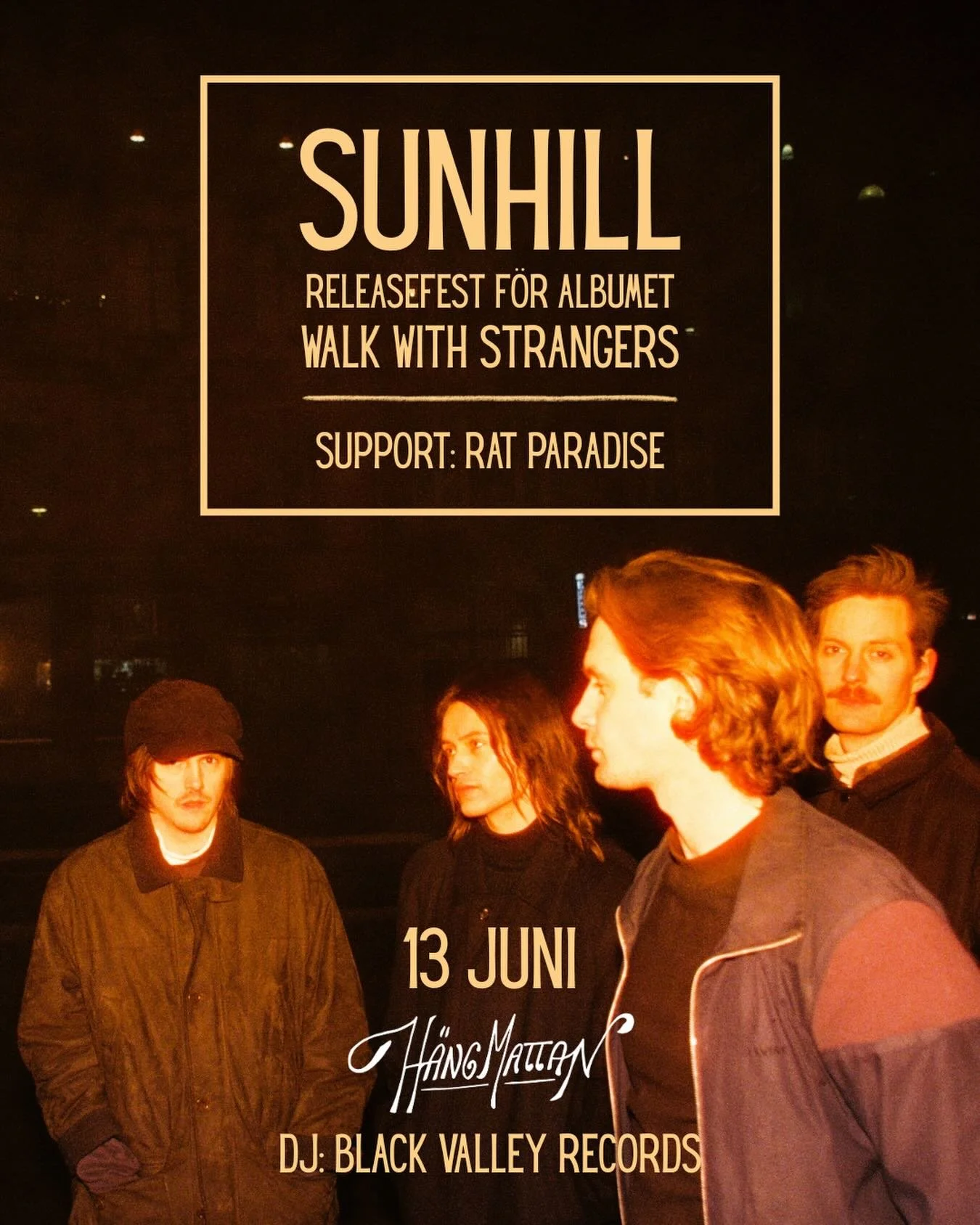
Their musical journey reaches a long-awaited milestone with the release of their debut album, “Walk With Strangers,” arriving on June 12. Recently, drummer Jack Petersson and guitarist Oscar Olofsson broke down the record and its latest singles.

YY: How does the deep personal history of having known one another for most of your lives shape your creative chemistry and musical philosophies as a band?
JP: I think you get to a certain point where you know each other so well, both musically and personally, that you understand how everyone plays and what style each person brings to a song. That creates a level of comfort that really helps when writing or recording together — sometimes you barely even need to talk and can just play. We’ve also never been afraid of being honest with each other, and nobody gets mad if someone tells them to try something differently.
Even though we all listen to a lot of different genres and artists, there’s still a shared foundation in the music we grew up on while first picking up instruments and later living together. So in a lot of ways we come from the same place, both musically and geographically.
For Oscar — what did you learn about yourself with the creative breakthrough of "Orbison?" How did the conflict that fed into it shape the greater album?
OO: “Orbison” was one of the last songs written for the album, and it came after a couple of months of feeling pretty uninspired creatively. Partly because of life stress and obligations, but also because I felt boxed into a certain way of writing.
I remember going home after the last day of my studies, and with a new sense of freedom I just wanted to write again. The song came out almost immediately, and that feeling of relief shaped both the sound and the lyrics.
Writing “Orbison” reminded me not to overthink things too much and just do whatever feels exciting or honest in the moment. I think if you keep living your life and keep writing, eventually something meaningful comes out when you actually have something to say.
“Orbison” was one of those breakout songs for me, and I think that desire for creative freedom and reinvention runs through the entire album.
Your earlier work is rooted in raw garage rock, but "Orbison" gives listeners a glimpse of a sound that's more murky and cinematic. What inspired you to bring in new sonic textures for the upcoming record?
Just the need to do something different and exciting every once in a while. We’d been talking about and experimenting with keyboard parts for a while, and I think that opened up the writing process a bit. We could approach songs in new ways and explore different textures and sounds.
We were free from the garage rock shackles, and suddenly putting a mellotron or a cello into a song didn’t feel so forbidden anymore.
How did recording at an industrial space in an area currently being gentrified impact the mood of the new track(s)?
JP: While I don’t think the area itself directly impacted the songwriting, since most of the material was written across different places and periods over several years — the atmosphere around it probably still seeped into the recordings in some way.
The album is very much shaped by our time in Gothenburg and by the feeling of moving through a city that constantly changes around you. A lot of the songs revolve around arriving with a romanticized idea of what life would become, and then trying to navigate nightlife, relationships, loneliness, stress and the feeling of time moving faster than you can keep up with.
After a decade as a band and several EPs, your debut album finally arrives in June. How does it feel to let go of these songs after living with them for so long?
It sure is a relief, when you’ve heard your own songs so many times and dissected them into atoms while producing them, you get to a point where you don’t even hear them as songs anymore. That’s usually when it’s time to let go and give them to other people.
Once they’re released, you start hearing them in a totally different way again, which I’m really looking forward to.
How do you plan to translate the softer elements of your new sound into the high-energy stage performances you've come to be known for?
We’ve started experimenting more with our live setup by bringing in percussion, acoustic guitars and, most importantly, synthesizers. That has helped glue everything together and fill out some of the spaces that are more present on the record. The softer songs have actually become easier to translate live with this setup, and having more breathing room in the set also makes the high-energy parts hit harder.
Aside from the major milestone of a debut album, what else is in store for the future of SUNHILL?
Right now we mostly just want to get out and play as much as possible, hopefully abroad as well. We’re really looking forward to finally bringing this album into a live setting properly.
At the same time, having finished a debut album makes the idea of another one feel a lot less scary. We already want to start working on the next thing — maybe writing and recording it more as one continuous session instead of several different periods stitched together like “Walk With Strangers.” More than anything, getting this album out just makes us feel a lot more free, and that usually leads to the most exciting stuff.
SUPPORT SUNHILL by listening, streaming, following. Support all artists mentioned in this interview. Support all artists.